Author Archive

Revolutionary Nanoparticle-Enhanced Plasma Pulse Stimulation: A Paradigm Shift in Well Stimulation Technology

Posted on: September 6th, 2025 by Mohamed Abdelsalam

Breakthrough electrified stimulation method delivers fracturing with minimal water and chemical footprint

Abstract

Introduction: The Stimulation Challenge

Current well stimulation technologies face significant operational and environmental limitations that constrain their application across diverse reservoir conditions. The industry urgently needs innovative approaches that can deliver consistent performance while addressing sustainability imperatives and operational challenges.

Limitations of Conventional Acidizing

Traditional acid stimulation operates within narrow windows of formation compatibility and temperature constraints. The technology proves most effective in carbonate formations but shows limited impact in shales and silicate reservoirs. Critical challenges include:

  • Formation sensitivity restrictions limiting universal applicability.
  • Temperature-dependent reaction kinetics reducing effectiveness in high-temperature environments.
  • Corrosion and scaling risks compromising wellbore integrity and equipment reliability.
  • Reaction byproducts that may reduce formation permeability.
  • Safety concerns associated with handling and pumping corrosive chemicals.

Hydraulic Fracturing Constraints

While hydraulic fracturing has enabled unconventional reservoir development, the technology faces increasing scrutiny over its environmental footprint and operational complexity:

  • Massive water requirements (millions of gallons per well) straining local resources.
  • Extensive chemical and proppant logistics increasing operational complexity and costs.
  • Growing regulatory and public concern over induced seismicity.
  • Inconsistent performance in heterogeneous or naturally fractured formations.
  • Large surface footprint requiring significant infrastructure and generating noise/emissions.

The PPPS Innovation: Electrified Precision Stimulation

Nanoparticle-Enhanced Plasma Pulse Stimulation represents a fundamental departure from conventional stimulation approaches, leveraging advanced materials science and high-energy physics to achieve superior results with minimal environmental impact.

Technology Overview

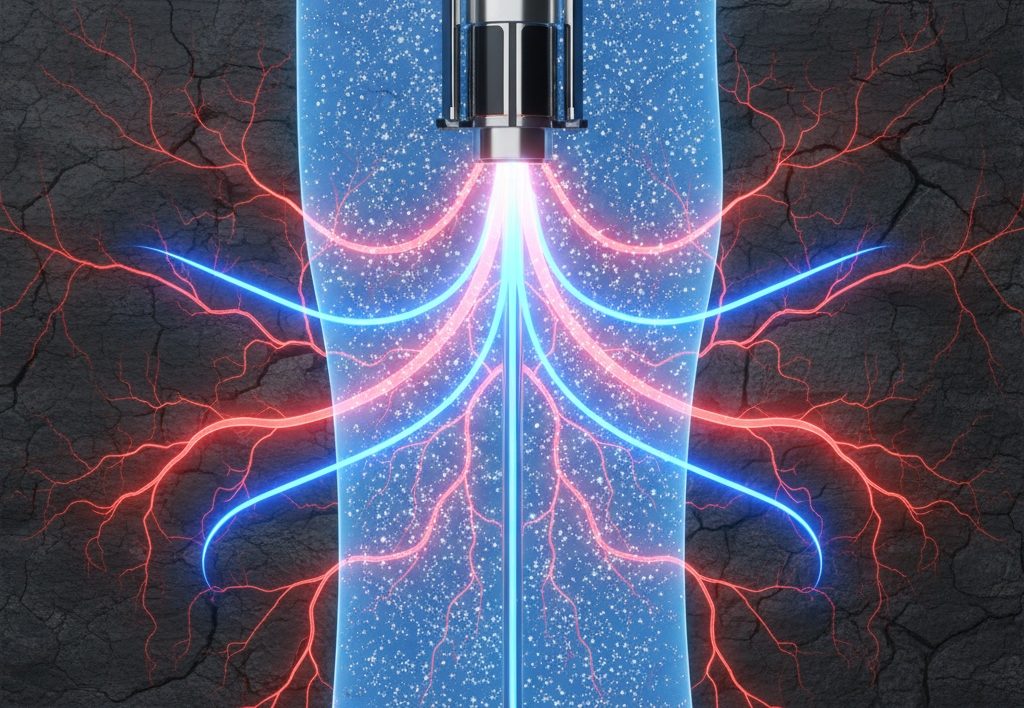
PPPS deploys surface-based capacitor banks that release microsecond-duration electrical pulses to a specialized downhole plasma tool delivered via coiled tubing. The system generates ultra-fast plasma discharges within a conductive nanoparticle fluid, creating thermite-like reactions that amplify energy to generate shock pulses exceeding 100,000 psi. This process creates and extends complex fracture networks , eliminating the need for large-volume fluid pumping.

Nanoparticle Fluid Innovation

The core of PPPS technology lies in its specially engineered nanoparticle-based fluid system, which is built from cost-effective materials and standard field components.

Design Principles:

  • Optimized for cleanup and formation compatibility
  • Low-residue formulation minimizes formation damage
  • Conductive properties enable efficient plasma discharge
  • Thermite reaction capability amplifies mechanical shock energy
  • No proppant required due to proven permeability enhancement around created fractures

Surface Capacitors

Surface-deployed high-energy capacitor banks deliver repeatable, high-intensity pulses with precise control:

  • Microsecond pulse duration minimizes structural load on tubulars
  • Adjustable electrode spacing accommodates various wellbore conditions
  • Durable design enables multiple shots per deployment
  • Compact surface footprint compared to conventional fracturing spreads

Flexible Downhole Assembly

The PPPS downhole tool features a ruggedized, multi-pulse design optimized for standard oilfield operations:

  • Compact bottom-hole assembly (20-25 feet) for coiled tubing deployment
  • Integrated packer option for zonal isolation
  • Casing collar locator (CCL) for accurate depth correlation
  • Advanced insulation technology for casing compatibility
  • Robust high-voltage cable connections within coiled tubing dimensional constraints

Operational Advantages and Value Proposition

Universal Reservoir Applicability

Unlike conventional stimulation methods limited to specific formation types, PPPS demonstrates effectiveness across all reservoir types:

  • Carbonates: Enhanced fracture complexity beyond acid stimulation capabilities.
  • Sandstones: Effective stimulation without formation sensitivity constraints.
  • Shales: Complex fracture network creation independent of mineralogy.
  • Geothermal: High-temperature performance where conventional fluids fail.

Environmental and Operational Benefits

  • Drastic Water Reduction: Eliminates millions of gallons of water per well, addressing water scarcity concerns and reducing logistics.
  • Chemical Minimization: Low-chemical formulation reduces handling risks, storage requirements, and environmental impact.
  • Compact Footprint: Single coiled tubing unit plus power supply replaces extensive fracturing fleets, reducing noise, emissions, and surface disruption.
  • Rapid Deployment: Streamlined operations enable faster mobilization and reduced well downtime.
  • Safety Enhancement: Eliminates high-pressure fracturing manifolds, acids, and proppant handling, significantly reducing operational risks.

Technical Performance Superiority

  • Deep Formation Penetration: Creates fractures deep within formations, not just near-wellbore enhancement.
  • Precision Placement: Zonal isolation with packer systems enables targeted stimulation without unintended fracture growth.
  • Integration Flexibility: Can complement hydraulic fracturing or operate as standalone treatment depending on reservoir requirements.
  • Larger Treatment Radius: Achieves extended stimulation radius with minimal surface logistics compared to conventional methods.

Field Trial Framework: Validating Revolutionary Technology Comprehensive Development Approach

The field trial program for the new Nanoparticle-Enhanced Plasma Pulse Stimulation (PPPS) technology follows a careful, multi-step process to thoroughly test and prepare it for commercial use. Initially, the technology is studied in the lab to understand how various field fluids and materials affect its efficiency. Next, computer models simulate the shock waves to refine the design for real-world scale. Then, specialized downhole tools are engineered and built for field deployment. Finally, a pilot campaign tests the system across multiple wells of different types, closely monitoring performance and adjusting as needed.

The trials focus on various well categories, including horizontal tight oil and gas wells, depleted vertical fields, water injection wells, and high-temperature geothermal sites, showcasing the technology’s versatility. Advanced monitoring tools like downhole cameras, pressure analyses, and electromagnetic sensors help capture direct fracture creation and measure improvements in flow and injectivity.

Success is measured by clear indicators such as increased productivity, confirmed fracture formation, improved pressure signatures, and preserved well integrity. This approach ensures that the revolutionary stimulation method is validated with rigorous data for widespread operational adoption.

Industry Transformation Potential

Addressing Critical Industry Needs

PPPS technology directly addresses the most pressing challenges facing the stimulation industry:

  • Environmental Sustainability: Dramatic reduction in water consumption and chemical usage aligns with corporate ESG commitments and regulatory trends.
  • Operational Efficiency: Simplified logistics, reduced equipment requirements, and faster deployment translate to significant operational advantages.
  • Universal Applicability: Single technology platform effective across all reservoir types simplifies operations and reduces technology risk.
  • Cost Optimization: Reduced consumables, logistics, and equipment requirements create favorable economic models, particularly for marginal wells and challenging environments.

Technology Readiness and Commercial Pathway

Patent Protection and Intellectual Property

The PPPS technology is protected by pending patents covering key innovations in nanoparticle fluid formulations, plasma generation systems, and integrated downhole tools. This intellectual property position provides competitive advantages and licensing opportunities for industry adoption.

Partnership and Collaboration Framework

Successful commercialization requires strategic partnerships spanning:

  • Operator Collaboration: Well nomination, site access, operational integration, and data sharing for technology validation
  • Service Company Integration: Tool manufacturing, pulsed-power systems, coiled tubing operations, and specialized fabrication capabilities
  • Technology Development: Continued innovation in nanoparticle formulations, plasma generation, and downhole tool optimization

Regulatory and Safety Considerations

PPPS technology offers inherent advantages in regulatory compliance and safety management:

  • Electrified operations eliminate many chemical handling and storage regulations
  • Reduced water usage addresses increasingly stringent water management requirements
  • Minimal chemical footprint simplifies environmental permitting processes
  • Lower operational complexity reduces safety training and certification requirements

Future Development Roadmap

Technology Enhancement Opportunities

Continued development focuses on expanding capabilities and optimizing performance:

  • Advanced Nanoparticle Formulations: Next-generation materials for enhanced energy transfer and formation compatibility
  • Intelligent Control Systems: Real-time monitoring and adjustment capabilities for optimized pulse sequences
  • Multi-Well Treatments: Simultaneous treatment capabilities for pad drilling applications
  • Integration Platforms: Compatibility with emerging completion and production technologies

Market Expansion Potential

PPPS technology applicability extends beyond conventional applications into specialized unconventional development:

  • Unconventional Reservoir Development: Enhanced stimulation in tight oil and gas formations where conventional methods achieve limited penetration.
  • Hybrid Fracturing Programs: Combined PPPS-hydraulic fracturing treatments for unprecedented formation access and connectivity.
  • Geothermal Development: Enhanced heat recovery in high-temperature environments where conventional methods fail.

Conclusion: A New Era in Well Stimulation

Nanoparticle-Enhanced Plasma Pulse Stimulation represents a revolutionary advancement in well stimulation technology, addressing the industry’s most pressing operational and environmental challenges while delivering superior technical performance. The technology’s ability to create complex fracture networks with minimal water and chemical requirements positions it as a transformative solution for the evolving energy landscape.

The comprehensive field trial program outlined provides a structured pathway for technology validation and commercial deployment. Through strategic partnerships with operators and service companies, PPPS technology can rapidly advance from laboratory innovation to field-proven commercial solution, delivering significant value to stakeholders while advancing industry sustainability objectives.

As the energy industry continues to evolve toward more sustainable and efficient operations, technologies like PPPS that combine superior technical performance with environmental responsibility will define the future of well stimulation. The opportunity exists now for forward-thinking companies to partner in bringing this revolutionary technology to market, establishing competitive advantages while contributing to industry transformation.

Call to Action

Industry leaders seeking to advance sustainable stimulation capabilities and establish technological leadership are invited to participate in the PPPS field trial program. Through collaborative development, companies can access cutting-edge stimulation technology while contributing to the industry’s sustainable future.

The transformation of well stimulation technology begins with visionary partnerships willing to embrace revolutionary approaches. Join the PPPS development initiative and help define the future of efficient, sustainable well stimulation.


For technical inquiries and partnership opportunities, contact the PPPS development team to schedule comprehensive technology presentations and discuss customized field trial programs tailored to specific operational requirements and reservoir conditions.
Prof. Dr. Mohamed Y. Soliman 

Son Nguyen

Mohamed Adel Gabry


Deep Learning and Wavelet Transforms Elevate Pressure Data into a Microseismic Diagnostic Tool

Posted on: September 3rd, 2025 by Mohamed Abdelsalam

Abstract

A breakthrough methodology has been developed that combines continuous wavelet transform (CWT) signal processing with deep learning to predict microseismic events during hydraulic fracturing operations. This innovative approach transforms treating pressure data into normalized CWT scalograms, creating unique signatures for different fracture propagation modes. The technique was validated using data from the Marcellus Shale Energy and Environment Laboratory (MSEEL) and demonstrates exceptional accuracy in predicting three-dimensional microseismic event clouds from treating pressure alone. The deep learning model achieves prediction errors below 0.025% for horizontal coordinates and below 0.2% for vertical coordinates, while generating results in near real-time (40 seconds for a 2-hour fracturing job).

Introduction

Understanding hydraulic fracture propagation events is crucial for optimizing completion designs, estimating fracture geometry, and maximizing production. Traditional methods like the Nolte-Smith technique and moving reference point (MRP) analysis, while useful, have limitations in real-time application and require complex workflows or prior knowledge of closure pressure.

Microseismic monitoring provides valuable insights into fracture propagation by detecting small-scale earthquakes resulting from rock ruptures during high-pressure fluid injection. However, microseismic monitoring is expensive and not always available. The ability to predict microseismic events from readily available treating pressure data would provide operators with critical fracture characterization capabilities at significantly reduced cost.

This study introduces a novel signal processing approach that treats hydraulic fracturing as an input-output system, where pumping rate and proppant concentration are inputs and treating pressure is the output. By analyzing the output signal using advanced CWT techniques, the method reveals fracture propagation dynamics without requiring simplifying assumptions common in traditional approaches.

Methodology

Normalized CWT Scalogram Technique

The foundation of this methodology lies in applying CWT to treating pressure data during hydraulic fracturing. CWT provides continuous scaling and shifting of wavelet functions, offering high resolution in both frequency and time domains. This makes it particularly suitable for analyzing non-stationary signals like treating pressure during fracturing operations.

Figure 1: The CWT mechanism involves comparing a selected wavelet (Complex Morlet Wavelet) to segments of the treating pressure signal, calculating correlation coefficients at different scales and time positions.

[Figure shows the wavelet transform mechanism: original signal → wavelet comparison at multiple scales → energy scalogram generation]

The process involves three key steps:

  1. Signal Analysis: A Complex Morlet wavelet is systematically compared to the treating pressure signal across its entire duration
  2. Scale Variation: The wavelet is stretched and compressed to capture both fine (high-frequency) and coarse (low-frequency) features
  3. Energy Calculation: Wavelet coefficients are squared to create an energy scalogram showing dominant frequencies at each time interval

The energy scalogram undergoes normalization using minimum-maximum scaling to ensure consistency across different fracturing jobs:

(log₂ E)ₙₒᵣₘ = [(log₂ E) – (log₂ E)ₘᵢₙ] / [(log₂ E)ₘₐₓ – (log₂ E)ₘᵢₙ]

This normalization creates normalized CWT coefficients ranging from 0 to 1, enabling direct comparison between different wells and formations.

Fracture Event Classification

The normalized CWT scalogram reveals distinct signatures for different fracture propagation modes:

  • Limited Width Propagation: Normalized coefficients 0.0-0.25 (blue regions)
  • Length Growth: Normalized coefficients 0.4-0.6 (green regions)
  • Height Growth/High Leak-off: Normalized coefficients 0.8-0.95 (red regions)

Figure 2: Example normalized CWT scalogram showing color-coded fracture propagation events over time. The scalogram acts as a “mathematical microscope” revealing subtle changes in treating pressure that correspond to different fracture behaviors.

[Figure shows heat map with time on x-axis, scale on y-axis, and color intensity representing normalized CWT coefficients, with distinct regions corresponding to different fracture events]

Deep Learning Architecture

The deep learning model employs a compact neural network designed specifically for regression tasks with tabular data. The architecture includes:

  • Input Layer: 256 features from normalized CWT scalogram
  • Hidden Layers: Sequential layers with batch normalization and ReLU activation
    • Linear(256→200) → ReLU → Linear(200→100) → ReLU
  • Output Layer: Linear(100→3) for X, Y, Z coordinates of microseismic events

Figure 3: Deep learning framework architecture showing the flow from CWT scalogram input through hidden layers to microseismic event coordinate prediction.

[Figure shows neural network diagram with input layer (256 nodes), hidden layers, and output layer (3 nodes for X,Y,Z coordinates)]

The model was trained on 256,555 data points from 48 hydraulic fracture stages in the Marcellus Shale, with a 70/30 train/test split. Stratified K-fold cross-validation with 10 folds ensured robust performance evaluation across different microseismic event distributions.

Results and Validation

Three-Case Validation Approach

The technique underwent rigorous validation through three distinct cases:

Case 1 – Simulated Fracture: Using a commercial planar 3D simulator with realistic geomechanical properties, the normalized CWT scalogram successfully identified three distinct fracture propagation stages, matching simulated fracture geometry evolution.

Case 2 – Field Data Comparison: Real field data from Well X1 was analyzed and compared with the previously validated MRP technique. The normalized CWT scalogram showed excellent correlation with MRP results while offering significantly faster analysis.

Case 3 – Microseismic Validation: Using MSEEL project data from wells MIP-3H and MIP-5H, the technique was directly calibrated against recorded microseismic events, providing physical validation of fracture event detection.

Performance Results

Figure 4: Comparison of predicted vs. actual microseismic events for Stage 20 in well MIP-5H, showing excellent agreement in both spatial distribution and temporal evolution.

[Figure shows 3D plot comparing actual microseismic events (blue dots) with predicted events (red dots), demonstrating spatial accuracy and event cloud similarity]

The deep learning model achieved remarkable accuracy:

  • X and Y directions: <0.025% error for training data, <0.02% for testing data
  • Z direction: <0.2% error for training data, with slightly higher but acceptable errors in testing
  • Processing Speed: 20 seconds to generate CWT scalogram, 40 seconds to predict microseismic cloud
  • Real-time Capability: Updates every 40 seconds during operations

Field Applications

The methodology was successfully applied to multiple fracture stages in the Marcellus Shale, demonstrating consistent performance across varying geological conditions. The technique accurately predicted:

  • Fracture propagation direction and extent
  • Temporal evolution of microseismic events
  • Three-dimensional fracture geometry development
  • Identification of height growth vs. length propagation periods

Industry Impact and Applications

Operational Benefits

This technology offers significant advantages for hydraulic fracturing operations:

Real-Time Monitoring: Unlike traditional microseismic monitoring, which requires expensive equipment and post-processing, this method provides near-instantaneous feedback using only treating pressure data.

Cost Reduction: Eliminates the need for dedicated microseismic monitoring equipment while providing similar insights into fracture propagation.

Enhanced Decision Making: Operators can make real-time adjustments to pumping parameters based on predicted fracture development, optimizing treatment effectiveness.

Completion Optimization: Understanding fracture propagation patterns enables better stage spacing, cluster positioning, and completion design.

Comparison with Existing Methods

Figure 5: Performance comparison between normalized CWT scalogram, MRP technique, and Nolte-Smith method showing superior event detection capability and simplified workflow.

[Figure shows side-by-side comparison of three methods analyzing the same treating pressure data, highlighting the clarity and detail provided by the CWT approach]

The normalized CWT technique offers several advantages over traditional methods:

  • No closure pressure required (unlike Nolte-Smith)
  • Simplified workflow (compared to MRP complexity)
  • Real-time capability with continuous updates
  • Higher resolution fracture event detection
  • Quantitative predictions rather than qualitative interpretations

Technical Innovations

Signal Processing Advances

The application of CWT to fracture analysis represents a significant advancement in signal processing for petroleum engineering. The technique:

  • Captures both transient and continuous fracture events
  • Provides time-frequency resolution impossible with traditional Fourier methods
  • Adapts to non-stationary nature of fracture propagation signals
  • Maintains mathematical rigor while offering practical applicability

Machine Learning Integration

The deep learning component successfully bridges the gap between signal processing and physical phenomena:

  • Transforms mathematical features into geological interpretations
  • Learns complex relationships between pressure signatures and fracture geometry
  • Generalizes across different formations and completion designs
  • Provides probabilistic predictions with quantified uncertainty

Implementation Guidelines

Data Requirements

For successful implementation, operators need:

  • High-resolution treating pressure data (1 Hz sampling recommended)
  • Pumping rate and proppant concentration records
  • Initial formation characterization for model calibration
  • Historical microseismic data for initial training (if available)

Workflow Integration

Step 1: Real-Time Processing

  • Continuous CWT analysis of treating pressure
  • Automated scalogram generation and normalization
  • Integration with existing data acquisition systems

Step 2: Event Prediction

  • Deep learning model inference on CWT features
  • Microseismic event coordinate prediction
  • Fracture geometry estimation and visualization

Step 3: Decision Support

  • Comparison with planned fracture geometry
  • Identification of unexpected propagation behavior
  • Recommendations for pumping parameter adjustments

Quality Control and Validation

Regular calibration against available microseismic data, pressure matching with fracture simulation models, and continuous refinement based on production outcomes ensure maintained accuracy and reliability.

Future Developments

Technology Extensions

Research is ongoing to expand the methodology’s applicability:

  • Multi-Formation Training: Developing models for different geological settings
  • Enhanced Physics Integration: Incorporating geomechanical constraints
  • Uncertainty Quantification: Probabilistic predictions with confidence intervals
  • Multi-Well Analysis: Simultaneous monitoring of pad drilling operations

Digital Integration

Future developments will focus on:

  • Integration with digital oilfield platforms
  • Automated workflow optimization
  • Machine learning model continuous improvement
  • Integration with production forecasting models

Economic Impact

Cost-Benefit Analysis

The economic advantages of this technology are substantial:

  • Microseismic Monitoring Savings: $100,000-500,000 per pad
  • Completion Optimization: 10-20% improvement in production through better fracture design
  • Reduced Treatment Failures: Early detection of screen-outs and poor propagation
  • Operational Efficiency: Real-time adjustments reduce non-productive time


Conclusions

This research introduces a paradigm shift in hydraulic fracture monitoring and analysis. The combination of advanced signal processing through normalized CWT scalograms with deep learning creates a powerful tool for real-time fracture characterization. Key achievements include:

  1. Breakthrough Accuracy: Prediction errors below 0.025% for horizontal microseismic event locations demonstrate unprecedented precision in fracture event prediction from treating pressure alone.
  2. Real-Time Capability: Processing times of 40 seconds for complete fracture analysis enable true real-time monitoring and decision-making during hydraulic fracturing operations.
  3. Comprehensive Validation: Three-case validation approach using simulated, field, and microseismic data provides robust confirmation of technique effectiveness across different scenarios.
  4. Operational Simplicity: The method requires only treating pressure data, eliminating the complexity and cost of traditional microseismic monitoring while providing similar insights.
  5. Universal Applicability: Successful application across multiple formations and fracture stages demonstrates the technique’s broad applicability in the petroleum industry.

The technology represents a significant advancement in completion engineering, offering operators the ability to optimize hydraulic fracturing operations in real-time while reducing costs and improving outcomes. As the industry continues to focus on efficiency and cost reduction, this methodology provides a practical solution that bridges advanced signal processing with operational decision-making.

The successful validation using publicly available MSEEL data demonstrates the technique’s reliability and sets the stage for widespread industry adoption. Future developments will focus on extending the methodology to additional formations and integrating with broader digital oilfield initiatives.

This work exemplifies how advanced mathematical techniques can be successfully applied to solve practical petroleum engineering challenges, providing both academic rigor and immediate industrial value.

You can read the details in the following paper Advanced Deep Learning for microseismic events prediction for hydraulic fracture treatment via Continuous Wavelet Transform

At ATCE 2025, we will evaluate the scalability of the model by validating its results against Rate Transient Analysis (RTA) for a Marcellus Shale well located 3–5 km away from the training dataset. (SPE-228059).

Wavelet-Based Water Hammer Analysis: A New Window into Fracture Complexity

Posted on: August 30th, 2025 by Mohamed Abdelsalam

Hydraulic fracturing has long relied on microseismic monitoring, tracers, and fiber optics to infer fracture geometry and complexity. Yet every stage of every well already contains a widely overlooked signal: the pressure oscillations that occur at pump shutdown, known as water hammer (WH).

In our recent SPE Journal publication (SPE-225459), we introduced a novel technique that transforms this free but underestimated signal into a powerful diagnostic tool. By treating water hammer as a damped harmonic oscillator and analyzing its pressure response with the Continuous Wavelet Transform (CWT), we extract damping coefficients that correlate directly with fracture complexity in the reservoir.

he workflow applies the CWT using a complex Morlet wavelet to isolate the dominant frequency ridge of the WH signature, then calculates the damping coefficient from the logarithmic envelope decay. When applied across multiple fracture stages in Marcellus wells, the damping coefficient trends correlated strongly with natural fracture density interpreted from image logs. This provides operators with a cost-effective, pressure-only method to evaluate induced fracture complexity stage by stage.

Value for Unconventional Reservoirs

Unconventional reservoirs depend on maximizing stimulated reservoir volume (SRV) through the creation of complex fracture networks. Traditionally, operators rely on indirect diagnostics such as production logging, tracers, or costly microseismic surveys to estimate fracture effectiveness. The WH-CWT method directly leverages existing pressure data to provide real-time, low-cost insights into fracture complexity, even in the absence of other diagnostics.

This is particularly valuable in resource plays where thousands of stages may be completed annually and marginal wells cannot justify the expense of advanced diagnostics. By linking damping behavior to fracture tortuosity and natural fracture interaction, operators can rapidly identify which stages achieved high complexity and which underperformed, supporting design optimization, well-to-well benchmarking, and economic decision-making.

Model Assumptions and Limitations

The model assumes that water hammer can be represented as a partially damped harmonic oscillator with an added exponential decay term to capture fluid leakoff effects. Under this assumption, damping is governed primarily by fracture tortuosity, interaction with natural fractures, and leakoff into the formation. The approach further assumes:

  • Immediate pump shutdown is necessary to avoid overlapping signals from stepped closures.

  • Consistent fracturing design across stages allows damping coefficient variations to be attributed mainly to differences in induced complexity rather than treatment changes.

  • The complex Morlet wavelet adequately captures oscillatory behavior and phase shifts in the WH signal.

While the method has shown strong correlation with fracture density logs and robust performance in Marcellus wells, operators should note that gradual pump shutdowns, noise, or highly heterogeneous reservoirs can complicate interpretation. Even in such cases, overdamped signatures often provide useful qualitative indications of poor fracture-wellbore communication.

Key findings include:

  • Damping coefficients serve as reliable indicators of fracture complexity and natural fracture intensity.

  • WH responses can be classified from high-amplitude oscillations to overdamped signals, reflecting changes in fracture tortuosity and communication.

  • Nonlinear optimization methods, especially basinhopping, successfully matched modeled WH responses with field data, achieving R² values above 0.86 in most cases.

This new approach leverages data already collected during every hydraulic fracturing stage, requiring no additional field instrumentation. The information is freely available and can be analyzed for each job. The only operational step is a hard pump shutdown for approximately five minutes—no special gauges, sensors, or extra procedures are needed. By reframing water hammer as more than background noise, this method unlocks valuable insights for fracture diagnostics, completion design optimization, and stage-by-stage performance evaluation.

For full methodology, mathematical formulation, case studies, and correlation with fracture density logs, see the peer-reviewed article in the SPE Journal:  SPE-225459 or watch our the following webinar : Decoding Induced Fracture Complexity: Water Hammer Damping Analysis with Continuous Wavelet Transform

Electrifying the Future of Well Stimulation

Posted on: August 29th, 2025 by Mohamed Abdelsalam

The Fracwave Research Group at the University of Houston has developed a new stimulation technology that is now field-ready for deployment. Known as Nanoparticle-Enhanced Plasma Pulse Stimulation (PPPS), this electrified method combines microsecond plasma discharges with engineered nanoparticle fluids to create complex fractures deep in the formation—without massive water volumes, chemicals, or proppant.

Why PPPS, Why Now

For decades, acidizing and hydraulic fracturing have been the mainstay of stimulation. Yet both face mounting limits. Acidizing works primarily in carbonates and carries corrosion and scaling risks. Hydraulic fracturing requires millions of gallons of water and extensive logistics, while concerns over induced seismicity and environmental footprint continue to grow.

The industry needs a stimulation method that is formation-agnostic, operationally efficient, and ESG-aligned. PPPS was designed precisely to fill this gap.

How It Works

Surface capacitor banks release controlled electrical pulses down coiled tubing to a rugged plasma tool. Once discharged, the tool ignites a nanoparticle-laden fluid. Thermite-like reactions amplify the discharge into shock pulses greater than 100,000 psi, generating fractures that extend well beyond the near-wellbore. The fluids are engineered for conductivity and cleanup, leaving no proppant behind.

What Makes It Different

PPPS is compact, precise, and versatile. A treatment requires only coiled tubing, a power unit, and the plasma tool—a fraction of the equipment footprint of a frac spread. The system is effective in tight oil and gas reservoirs, depleted producers, water injectors, and even high-temperature geothermal formations where conventional fluids fail. By eliminating water and proppant demand, PPPS offers a significant cost and logistics advantage, while also aligning with corporate sustainability commitments.

Ready for Field Pilots

Following extensive design and validation, PPPS is now prepared for multi-well pilot trials. Candidate applications include horizontal producers where enhanced connectivity is needed, vertical wells where near-wellbore damage limits performance, and injectors where increased index is sought at lower pressures.

Performance will be measured by fold-of-increase in productivity or injectivity, fracture confirmation through imaging or logging, and diagnostic improvements in pressure transient and rate transient analysis. The safety case is strong, with short-duration pulses, precise zonal placement, and reduced surface intensity.

Collaboration Opportunity

Fracwave is now inviting operators, service companies, and technology partners to join in bringing PPPS into the field. Operators can nominate wells and provide performance data, while service companies can support tool manufacturing and integration. In return, collaborators gain early access to a disruptive technology with the potential to reduce costs, lower environmental footprint, and improve well performance across reservoir types.

A Call to Action

The transition to cleaner, more adaptable stimulation is already underway. With PPPS now field-ready, the next step is collaboration. Fracwave is preparing a kickoff workshop to align specifications, finalize candidate wells, and begin deployment planning.

PPPS offers efficiency, sustainability, and performance in one package. The question is no longer whether the technology works—it is which companies will move first to prove it in the field.

How Companies Can Collaborate

With PPPS now field-ready, the next step is industry collaboration. The Fracwave Research Group invites operators, service companies, and technology partners to join in advancing this technology through structured multi-well pilots.

Operators can contribute candidate wells across diverse applications—tight oil and gas horizontals, depleted producers, injectors, and high-temperature geothermal wells. In return, they gain first-mover access to field data demonstrating how electrified stimulation can lower costs, reduce water use, and improve recovery.

Service companies can support with tool manufacturing, coiled tubing integration, and pulsed-power delivery. This creates the opportunity to establish a new service line built around compact, electrified stimulation instead of conventional large-scale frac fleets.

Technology partners and investors can collaborate on scaling the surface capacitor systems, refining nanoparticle fluid supply chains, and accelerating deployment across basins. Their involvement ensures the system can move quickly from pilot to commercial scale.

Together, these collaborations form the backbone of PPPS deployment. By sharing wells, expertise, and operational data, partners not only help validate the technology but also position themselves at the forefront of a cleaner, more efficient future for well stimulation.

Contact us to discuss more.